Your doctor says that your back pain is caused by strained muscles. Your friend states it could be a slipped disk. Your colleague indicates that it's an age thing. It gets complicated — but it doesn't need to be.
Many people think that back pain is always a serious spine issue. Some think surgery is the only solution if pain continues. They're not necessarily always true.
It's essential to recognise that a lot of back pain has a strong connection to lifestyle, habits and posture. Many cases will improve without surgery, if diagnosed early, without the need for long-term complications.
Here you will find some insight into what is going on in your back and some simple things you might be doing that may be contributing to your back pain—without you realizing it—and how you can correct them.
Do Our Daily Activities Cause Back Pain?
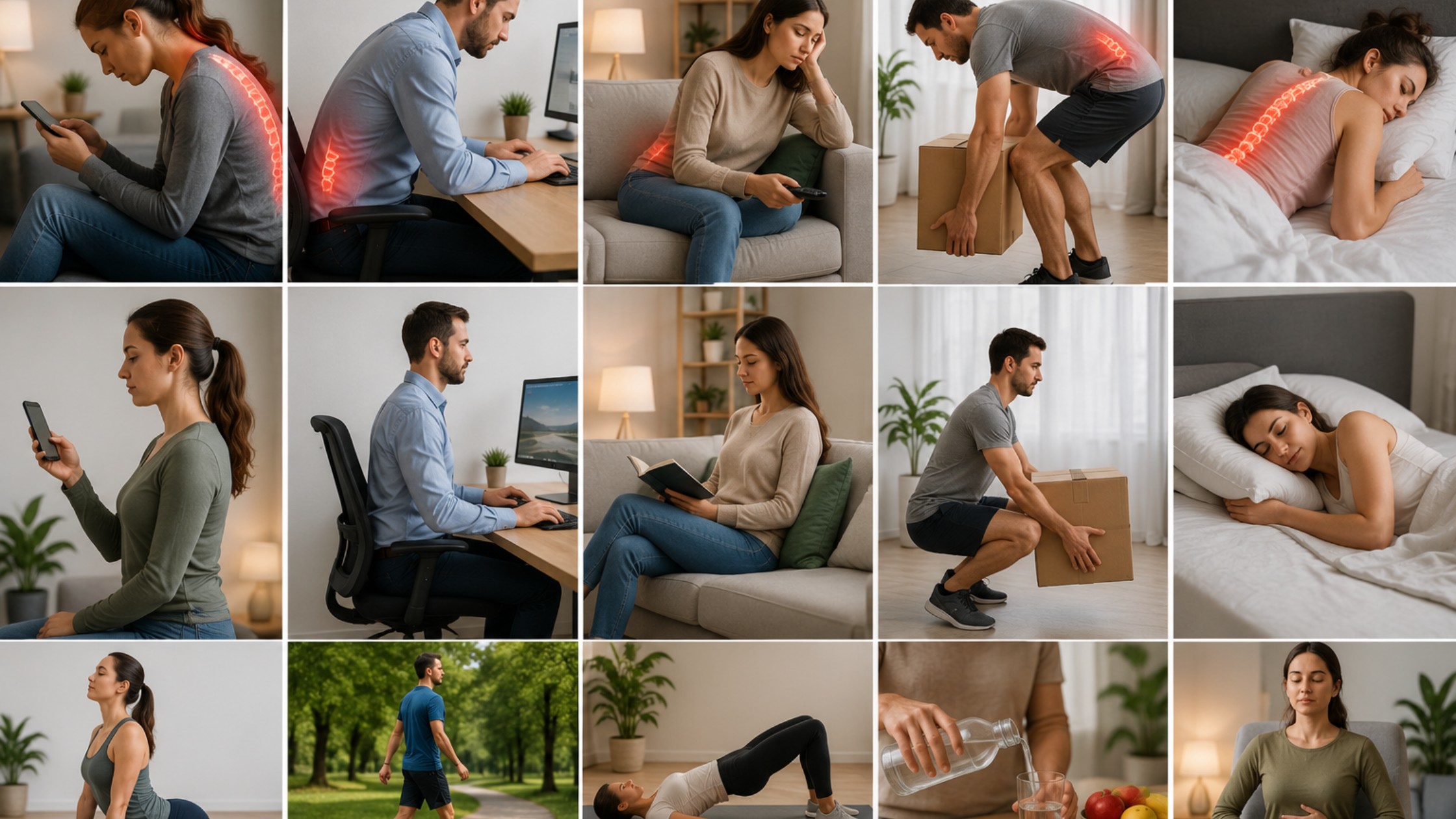
The short answer is, yes, in most respects.
Often back pain isn't a disease. It can be caused by stress, strain or imbalance in the muscles, ligaments or spinal joints.
Your spine is the foundation for your whole body. Doing the same thing over and over can cause the spine and surrounding muscles to become overloaded over time. This results in stiffness, inflammation and chronic pain over time.
That's why some people can have a low back problem and others do not have one, even though they live the same lifestyle and experience the same stress.
1.Sitting for Long Hours Without Movement is the first rule.
Long sitting hours are one of the most prevalent reasons for back pain today. Sitting at a desk, driving and spending time on screens create less room for your spine to move and place more pressure on your lower back.
Sitting for extended periods of time eventually causes the spinal discs to compress and the muscles to weaken.
What you should do:
Make frequent short breaks (30-45 minutes). Regularly stand, stretch and reset posture.
2. Overuse of Mobile Phones (Text Neck)
When using a mobile phone, the neck is bent forward, which puts strain on the neck's spine. It is sometimes referred to as “text neck”.
This eventually causes stiffness of the neck, pain in the shoulders and upper back.
What you should do:
Use your phone at eye level, and limit long, continuous scrolls.
3. Sitting postures that are poor at work and/or home
This uneven stress on the spine occurs when sitting slouched or leaning forward. This can cause muscle fatigue and back strain in the lower back.
What you should do:
Sit with your back, shoulders and feet supported and relaxed on the floor.
4. Improper Driving Position
Sitting for long hours in an un-supportive seat can have a great effect on the lower back and neck.
What you should do:
When driving, sit up straight with knees slightly bent in the vehicle.
5. Poor Core Muscle Strength, No Exercise
You have natural support for your spine which is your core muscles. If they're not strong, your back has to bear extra weight.
This makes it more likely to develop a chronic back problem.
What you should do:
Add walking, stretching or basic core strengthening exercises into their daily routine
6. Not using a pillow or blanket.
Mattresses that are either too soft or too worn out do not support your spine. This can lead to pain and stiffness in the morning.
What you should do:
Have a firm, although medium, mattress that supports the natural curves of the spine.
7. Incorrect Lifting Techniques
When lifting heavy objects, bending the back rather than the knees puts pressure on the lower spine as it is suddenly stretched.
What you should do:
Always lift with the legs, keep the object close to the ground, and bend the knees when lifting.
8. Low Blood Pressure
This additional weight accentuates constant pressure on the joints of the spine, particularly in the lower back.
What you should do:
Minimal weight loss can make a big difference in relieving back strain and mobility.
9. Failure to identify Early Warning Signs
Any stiffness or pain or discomfort is not considered a problem until it progresses to a significant level.
What you should do:
If it is not resolved within a few weeks, seek early evaluation.
10. Stress and Poor Sleep Quality
When stressed, muscles tension up, and when sleep is poor, the body is unable to recover. They both aggravate back pain.
What you should do:
Keep a regular bedtime schedule and use relaxation exercises.
Early Evaluation of Back Pain Matters - Why?
Back pain is not necessarily a bad sign, but failure to treat it can increase recovery time and make treatment more difficult.
Early diagnosis helps in:
How to tell the difference between muscle and disc pain
Preventing chronic conditions
Refrain from unnecessary medicines or treatment/surgery
Effectively plan for non-surgical recovery
When to Seek Expert Advice?
If you have a pain specialist available, you should see him or her if:
The pain lasts longer than 2-3 weeks
Legs or numbness in legs radiates from pain.
Activities begin to become challenging on a daily basis. Daily activities start to be challenging.
The pain gets worse as time goes by.
FAQ
1. Is back pain always due to spine problems?
No. In most cases back pain is not caused by serious damage to the spine but by poor posture, muscle strain or lifestyle choices.
2. Is there a nonsurgical treatment for back pain?
Yes. Physiotherapy, posture correction, exercise and advanced pain management techniques prove to be very effective in many cases.
3. How long does it take for habits to heal back pain?
The prognosis varies, but if caused by early-stage pain, recuperation is likely within weeks with proper care.
4. When is back pain "problematic"?
If the pain is ongoing, radiating or interfering with movement, then medical evaluation is recommended.
Final Note
Often, back pain is not a big problem, but a small problem that adds up over time. The great news is these habits can be corrected early too and thus, prevent any long-term complications.
👉WhatsApp us today
👉Phone : 9677375851
👉Visit our specialist for consultation
Dr.Rajarajan Balasubaramanian, MBBS,MD,DNB,FNB (WIP,USA,DABRM(USA)
India’s first National Board and America Board Certified interventional pain specialist. Pain Management specialist at Dr RRB Pain Care , Maraimalai Nagar, Chennai.