A shoulder ache can make simple tasks, such as reaching up, lifting groceries, or even sleeping, uncomfortable and challenging. The problem is that several different shoulder conditions can cause the same type of symptoms and it's hard to determine which causes the pain.
Dr. RajaRajan Balasubramanian, FIPP, DABRM – India's first dual board-certified pain specialist at Dr. RRB Pain Care, Singaperumal Koil is frequently called in to assess patients who have been told conflicting information about their shoulder issues. Some are told they have a rotator cuff tear, others hear it is frozen shoulder or some are diagnosed as having shoulder arthritis. All three conditions lead to pain in the shoulder, but each condition has a different cause and treatment.
This guide breaks down the shoulder pain causes and diagnosis process into easy-to-understand terminology, so you can get an idea of what type of condition might be compatible with your shoulder pain before you make an appointment with a professional to get an assessment.
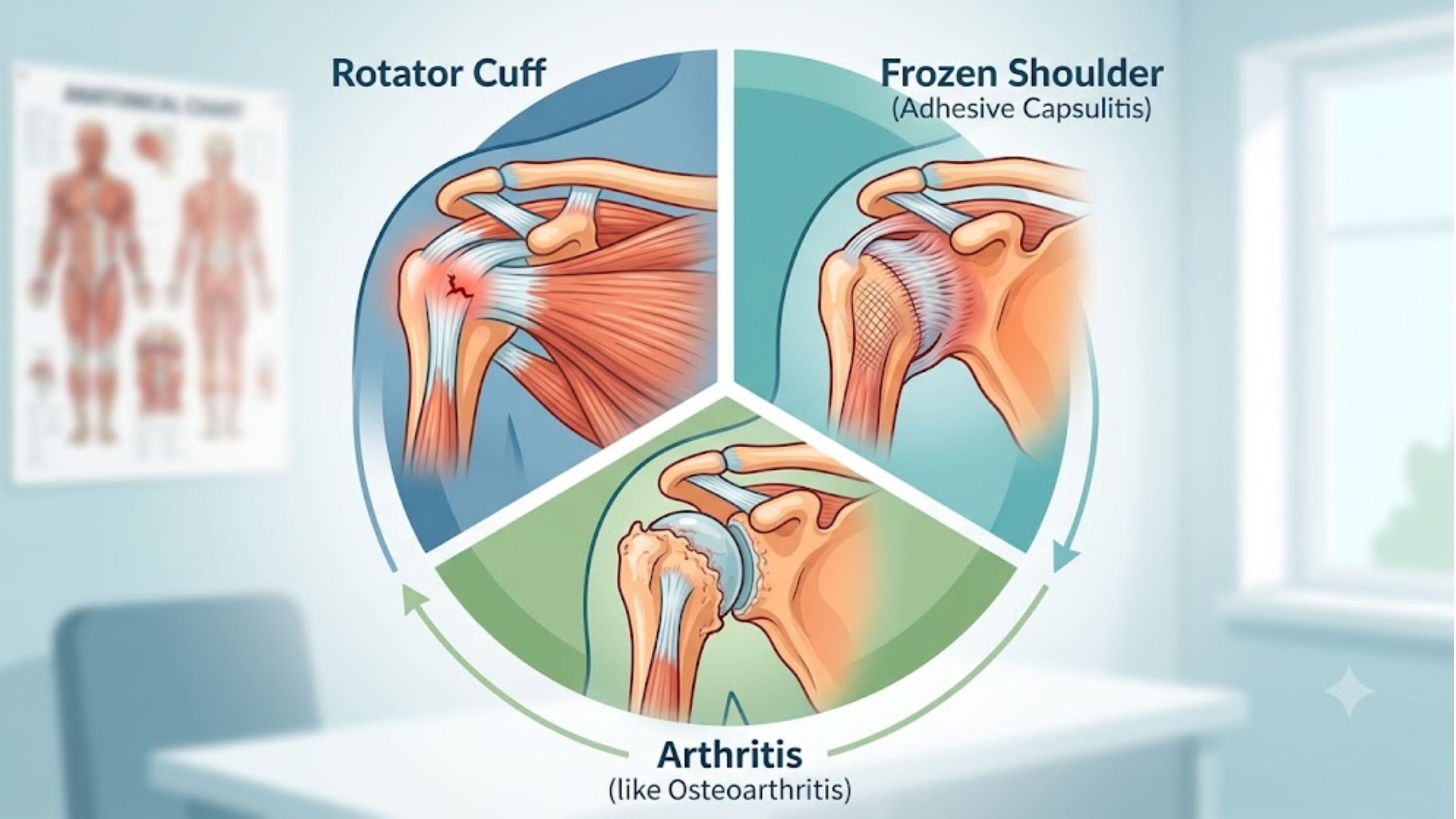
When the Joint Capsule Tightens, the result is Frozen Shoulder.
Also known as 'adhesive' or 'frozen' shoulder, this is when the capsule around the shoulder joint becomes thick and tight. Gradually over time, the shoulder's range of motion is lost in all directions as the capsule contracts.
It typically begins slowly and over weeks or months, and is more common in adults ages 45 through 65.
Common Symptoms
A gradually worsening stiffness of the shoulder that affects both sides.
Pain reaching over or behind your back
Trouble with combing hair or putting on clothes
Loss of ability to move in all directions.
Often pain that is worse at night
Frozen shoulder is not primarily a weakness problem as tendon injuries are.
The major difference many people will see between frozen shoulder and rotator cuff is that a frozen shoulder will make nearly all shoulder movements hard rather than just one.
Learn more:
frozen-shoulder
If the tendon of the rotator cuff tears, this condition is known as Rotator Cuff Tear.
The rotator cuff is a collection of muscles and tendons which holds your shoulder in place and aids in moving your arm up and around. A tear can be caused by an injury or from the aging process.
Some tears can happen suddenly after lifting heavy objects or some tears can be formed slowly over a few years.
Common Symptoms
The arm does not lift off the floor when the arm is raised to the side.
Weakness in upper body during overhead movements.
Difficulty reaching shelves
Pain when arm is lowered
Pain that worsens at night, especially at night while lying on the painful side
Many patients ask:
"When lifting my arm my shoulder hurts, what should I do?"
If the pain is primarily felt during lifting movements, but the shoulder is not immobile, there is an increased likelihood of a rotator cuff problem.
Passive movement with another person might not be as restricted as in frozen shoulder.
Learn more:
rotator-cuff-tearShoulder Arthritis — Cartilage is worn.
Arthritis of the shoulder is caused by the gradual loss of the smooth cartilage in the joint. This protective cartilage is important because it prevents bones from rubbing against each other and causing pain and stiffness.
It occurs more frequently after the age of 55 and can result from previous injuries or years of joint wear.
Shoulder Arthritis Symptoms
Shoulder pain that is deep, aching and persistent.
Morning stiffness
A grinding/clicking feeling.
Decreased ROM (range of motion)
Pain during everyday activities
Common symptoms that patients report are the experience of hearing or feeling a grinding sensation during shoulder movement.
If you have asked yourself whether your shoulder pain is arthritis or tendon, it is likely that arthritis does not just affect the strength of the tendon and instead will affect the entire joint and cause a gradual stiffness in the joint.
Learn more:
shoulder-joint-arthritis
Compare Frozen Shoulder, Rotator Cuff and Arthritis side by side.
Consistently shuffled down the list were the frozen shoulder, rotator cuff tear and shoulder arthritis.
The options include: Pain care and rehabilitation, physiotherapy, joint preservation treatments and PRP.
According to one of the world's most searched questions, here is the answer for you.
How to determine whether I have a frozen shoulder or rotator cuff?
When the shoulder is stiff in all directions it increases the likelihood of developing a frozen shoulder. If lifting is weak, painful and the shoulder can move, it could be a rotator cuff problem. If pain occurs slowly, with grinding and stiffness in the morning, then arthritis is a more likely diagnosis.
Can you have two or more conditions?
Yes. It is not unusual to experience more than one shoulder problem simultaneously after the age of 55.
For example:
Frozen shoulder and partial tear of the rotator cuff.
A tear of the rotator cuff and early arthritis.
Tendon Disorder associated with arthritis.
Chronic stiffness that leads to loss of strength in the muscles.
That's why imaging isn't always sufficient. A detailed physical examination, along with musculoskeletal ultrasound assessment, will help to determine which structure is causing your symptoms.
If diagnosed correctly, treatment can be directed to the actual cause of the pain, rather than the symptoms.
Pain in the shoulder is evaluated by the following shoulder pain assessment near Tambaram, Kattankulathur, and Singaperumal Koil.
When looking for shoulder pain treatment near me, the first step on the road to recovery is the correct diagnosis.
Dr. RRB Pain Care is a frequent visitor to patients from Tambaram, Kattankulathur and the entire GST Road corridor for thorough ultrasound evaluation of their shoulder.
Approximate travel times:
Tambaram: 25–30 minutes
Kattankulathur: 10–15 minutes
Maraimalai Nagar: Approx 10min
Singaperumal Koil: Local access
Clinic Address
Dr. RRB Pain Care
GST Road No.1/164, Singaperumal Koil, Tamilnadu 603204An ultrasound assessment may be enough to determine whether your pain is due to a frozen shoulder, tendon injury, arthritis, or a combination of conditions if you are looking for a shoulder pain doctor on GST Road.
Service areas are also available nearby. You can also try out our nearby services:
Tambaram
Kattankulathur
Call us today via WhatsApp to schedule a shoulder assessment.
Frequently Asked Questions
How can I determine if I have a frozen shoulder?
The most significant one is that the shoulder is unable to move in nearly all directions. The shoulder doesn't move even if someone else attempts to move it. Diagnosis is confirmed by a clinical evaluation and/or ultrasound.
Is there a chance of healing with a rotator cuff tear without surgery?
If it's a partial injury, pain management via ultrasound, activity modification, and regenerative treatment (where appropriate) and physiotherapy often help. If the tear is larger or complete, it should be surgically evaluated.
Is shoulder replacement surgery always indicated in the event of arthritis?
No. Treatment with non-surgical methods, physiotherapy, lifestyle changes and image guided interventions can be effective for many patients. The surgery to replace the shoulder is typically not offered until the arthritis in the shoulder is more severe and other treatments are not successful.
Is it possible for a frozen shoulder and rotator cuff tear to occur simultaneously?
Yes. This association is fairly frequent in older adults (age 55). The diagnosis is crucial, since the treatment varies for each disease.
Who is the near Tambaram shoulder pain doctor?
For chronic shoulder pain, stiffness and weakness, see a pain expert who specializes in musculoskeletal ultrasound evaluation. Dr. RRB Pain Care at Singaperumal Koil is known to be one of the most popular clinics in the premises of Tambaram, Kattankulathur and other surrounding areas for evaluation.
Conclusion
Numerous changes in the shoulder can have similar symptoms, but the cause will be entirely different. Knowing the process of how shoulder pain is diagnosed can help you realize if your symptoms are more consistent with frozen shoulder, rotator cuff tear, shoulder arthritis or a combination of these.
Correctly diagnosing the situation allows for more effective treatment, prevents delay and helps restore function to the shoulder as quickly as possible.
Dr. RRB Pain Care on the GST Road, Singaperumal Koil, has one solution: one ultrasound. Make an appointment today for an assessment or call us on WhatsApp | Phone: 9677375851.
Dr.Rajarajan Balasubaramanian, MBBS,MD,DNB,FNB (WIP,USA,DABRM(USA)
INTERNATIONAL PAIN & SPAIE SPECIALIST
India's First National Board and American Board Certified Specialist Dedicated to restoring quality of life through precision interventional pain management.